

No Reason.
I just thought
it was clever.


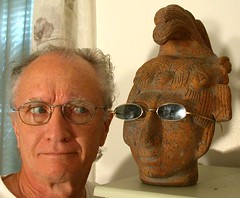 Things ain't what they used to be. Things ain't what they used to be.
(In fact, they never was.)
The Profile (more than you really wanted to know) is here.
|
Hello,
My name is Kate and I am a graduate student in the Master of the History of Decorative Arts, Design, and Culture at the Bard Graduate Center in New York. Currently I am taking a class on American Collectors and Collections, and I am writing my final paper about collectors of vernacular photography on Flickr. I'm a photographer myself, and a very small-time collector with a meager collection of snapshots and postcards. I'm really interested in exploring why collecting vernacular and snapshot photography has become so popular recently, and exploring the afterlife of the images on the internet.
If you are interested, I'd love to get your response to a few questions I have about your collection and the motivations behind your collecting practice. Your collection is large, and has some very intriguing images. Any insight would be much appreciated, as I hope to include thoughts from the collectors on Flickr into my paper. I can be reached on Flickr, or at (email address). Thanks for considering my request!
Cheers,
Kate
----------------------------
Kate
Thanks for your note. I hope I can contribute something that will be useful to you.
A friend of mine told me once that there are two kinds of collectors. There are those that want to collect all of something and there are those who want to collect one of everything. “Completers” and “Samplers” he called these. His simple definition probably covers most of the hobby collectors.
However, the photograph collector doesn’t exactly fit either of these categories. The “completer” collector knows at the outset that there is no possibility of collecting all photographs or even all of a type of them. The “sampler” knows also that there is an infinite variety and that finding one of each is impossible. Each photograph is unique. Size, subject, origin, format, age and content are factors.
So photo collectors often just set other limits. They pick formats like slides and cabinet cards, subjects like groups or cars, or eras like WW2 or certain decades.
My own limitation in photo collecting is not well defined. When I sort through a pile of photographs in a flea market or junk store, I do look for a few specific things in content: vehicles, toys, clothing or buildings. But mostly I watch for photographs that speak.
Sometimes one can actually hear the conversation that was going on. “Oh, you look great in that outfit. Let’s go outside and take your picture.” And so we have a photo of a woman standing in front of the house and she is now saying, “Hurry up, it’s cold out here.” (See: Vonda the Giant)
And occasionally I find the photograph that asks me, “Who could have thrown this lovely photograph away?” even if they had no real connection with it.
Perhaps the availability of the home flat-bed scanner has something to do with the growing popularity of old photographs. I purchased my first scanner about 1994. It was one of only seven models on the market. It required a special board to be added to a computer and was priced at $995. I bought it and had it installed largely to digitize photographs so I could share them with others.
Today, plug-and-play scanners at less than a hundred bucks have made digitizing photographs within the realm of every collector.
Consider also that in the 1950’s “old” photographs were rarities and were mostly about 50 years old, a scant few of them 100 years old. Today, there are millions of “old” photographs fifty to one-hundred years old.
Add the sobering fact that the generation which experienced the blossoming of photography beyond the studio, is now dying or deceased. The subjects in the primitive box camera photographs taken in the 20’s and 30’s are now long gone as are probably, the photographers themselves.
The “Me” generation loaded Great Grand-Mother’s useless old stuff into estate sales and dumpsters. Millions pass on with no surviving family. Their precious belongings end up on the flea-market tables.
A camera is as close as we will ever be to a time machine. A photograph is something special. Most of the photograph collectors I have talked with, feel that we are not collecting at all, we are rescuing; we have some higher purpose.
Please excuse the extended babble; I am sure that you have already considered all of this before.
I am placing your note and my rambling answer on my blog for today. It’s not a new ramble.
I will be happy to answer any questions you may have. I will try to be brief but I can’t promise it.
Fred
|

These are
the most popular pages:
Alison Young
Art Pepper
Barney Kessel
Bettie Page
Curl-up-and-dye
Edgar Degas and the lost Ginger Nude
Ginger Panda
Gnat Trap
Little Annie Fannie
Marilyn
Resident Alien
Sunday Funnies

|


0 Comments:
Post a Comment
<< Home