Thinks happen

Comments and journal pages.

20061004

JKonig's "drama queen"


drama queen
Originally uploaded by JKonig.

This is what Jennifer König says about her photograph which she titles "drama queen":

"ok let me say right off the bat, this AIN'T how the sky looked. it was really rather drab and grey, with a somewhat funky cloud formation. but like a little girl who turns her toybox upside down on the living room floor, i decided to play with it, to see what drama lay hidden within the pixels. mostly i tinkered with the levels and saturation, coaxing out that little slice of yellowy orangitude from its hiding place under the couch.p.s. check out this cool photo manipulation from P Doodle... (i had no idea he'd posted that, so i like to think of it as more of flickr's "serendipity syrup," as nj dodge rightly calls it.) "

So I thought about it all moring. I started to comment on Flickr about the photo and the post processing philosophy but decided it was too much. So I put it here instead.

The finished image is what counts.

This comes from a photog that carried 35mm film cameras for almost 50 years. I strove all that time to make the end result be the same as it came from the camera. Darkroom work was simply too strenuous and expensive and worse, somehow it seemed like devious misrepresentation. Available light, candid angles and fast film ruled my photographs.


Good boy. Jam
The candid shot was supreme.

Today, with a digital camera, I still strive for that natural shot, the picture that looks just like it looked when I was there. But now, “darkroom” work is no longer strenuous or expensive or devious. And it is no longer a personal taboo. It is part of the process. If a shot needs a bit of enhancement to make the photo convey what I “felt” at the time, then that is part of the process. Indeed, it is part of the art.

I think perhaps I suddenly needed to either “vent” or “come-out” (borrowing some of today’s vernacular) on this subject. I ranted on for a couple paragraphs so I blogged this instead to avoid taking up JKonig's comment space. It’s just personal opinion anyway.

(Candid shots rule forever!)


Can anyone identify this painting?
Click for larger version.


A very,merry unbushday to you!
Go HERE!
It's a hoot!


Yes, I refuse to use
Kleenex
until
THIS
stops.


Labels: , , ,

20061002

Girl One


Things ain't what they used to be. (In fact, they never was.)
The Profile (more than you really wanted to know) is
here.


Babs looked around.

When a guy walks down the street he just goes somewhere.

When a girl walks down the street, she turns heads, changes minds, destroys concentration, stimulates imagination and stops traffic.


These are
the most popular pages:
Alison Young
Art Pepper
Barney Kessel
Bettie Page
Curl-up-and-dye
Edgar Degas and the lost Ginger Nude
Ginger Panda
Gnat Trap
Little Annie Fannie
Marilyn
Resident Alien
Sunday Funnies


Labels: , , , , ,

20061001

Details

Details

meagain625 says:
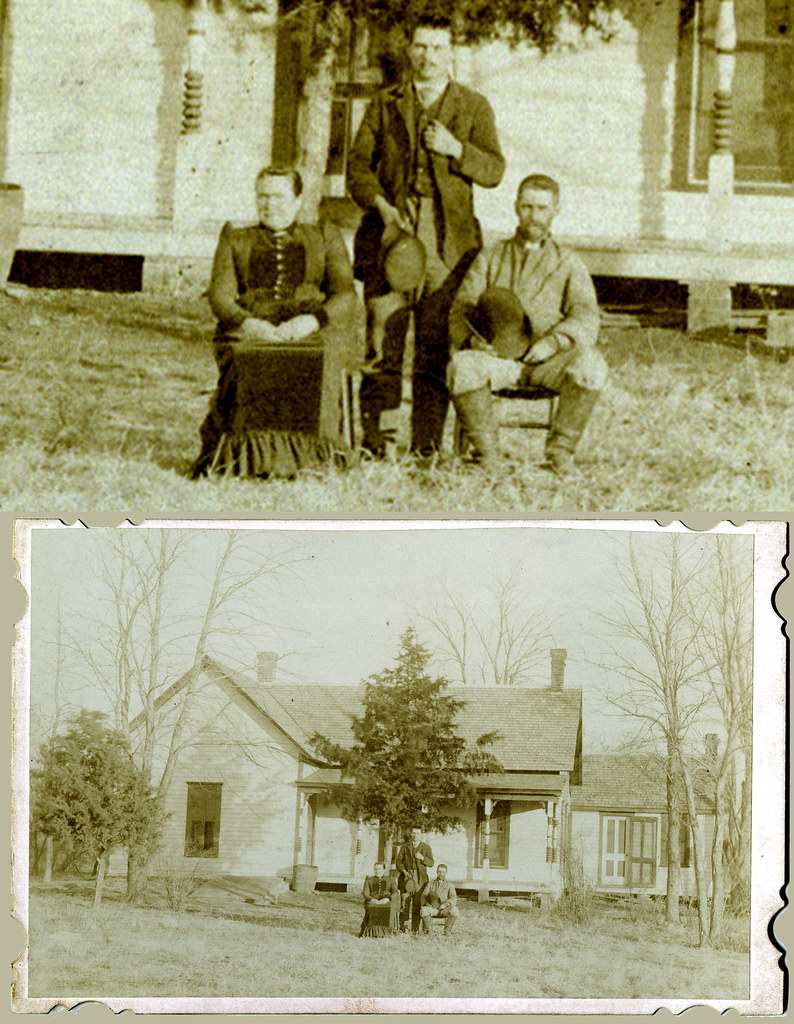
I could be wrong (I know, I know...it has happened) but it looks like the house was recently built, down to the new paint on the porch columns. Is that house behind it the same size (a developer bought up land and built on the property?) or a smaller storage type building? And why do I expect someone to know all the details on a found photo? What is with that? :)

anyjazz65 says:
Hm. You posed some very good questions there. Another look at it brings some discoveries and some more questions. First, I thought that it was just one building but I am not sure now. There are three chimneys showing. If it was a very big house, it would perhaps require three. Two were more common, as one for the living area and one for the kitchen as they were still cooking at the hearth then. If an extension were build to accommodate more children then a third might be required. However, there could be two separate buildings too.

Did a developer acquire land to build tract houses? Probably not. Most houses were individually built back then with only meager planning. Actually these looked at first like a home (or two) that had been moved there from another location. See the makeshift foundations and the extra lumber stuffed beneath. But then I noticed the cellar door. (There is a classic cellar door and rain barrel here!) The likelihood of there being a cellar already dug there and moving a house over it is pretty thin. Look at the trees. They surround the lot. The house was probably built there, not moved into place.

But look at the “second” house. The screen door is standing open, there is no porch and there are no steps. The door does seem to be painted the same as the door on the closer house. It is too good for a farm utility building, barn, tool shed. It must be a second house. Families often did that back then. The son would marry and bring his wife home. They would build a house on the same property and continue farming the land as a bigger family. Some towns got started that way probably.

The windows of the two buildings are not identical. The closer one appears to be a double hung, two pane window. The other seems to be a “French” window with small panes. The third window, the one on the left is shuttered with an exterior mounted shutter.

The chimney design seems the same on all three.

The siding and roof appear to be the same on both buildings.

There are a lot of details that could point to it being one building and a lot in favor of it being two separate buildings.

I still don’t know.

This is a long shot, obviously intended to be a picture of the homes more than a portrait. If it was intended to be a portrait of the extended family and their respective homes, where are they?

The shadows indicate the sun is low over my right shoulder. I think it is late in the day and we are facing east. The front door would thus be protected from the prairie north wind.


meagain625 says:
Of course! I missed the cellar door. I did notice the trees were already established , but my mind didn't really dwelve into that area much, knowing that some build around them. I had noticed the door on the other house, and how it was not set up like the door/porch on the first house, that's what made me think of it as separate. It appears to be more like a back door, maybe the houses are back to back to allow the new wife to have her own garden and lawn area.I love the puzzles these bring out. It stretches my mind to be able to sit and speculate, something not normally done if you are looking at the photograph unless it is there in front of you for a while and reminding you: Look at me, think of me... (does that even make sense?)


anyjazz65 says:
Absolutely. If a photograph can take you into it and give your mind an exercise then it has well done its job.Yes, back to back houses seems a logical set up to me also. The only thing that still bothers me is: why did they need two houses for just the three of them? Normally it would be too expensive to build a house for just one son. And look: the guy on the right has muck boots with the pants tucked in and a utility farm hat as if he just came from the corral...the guy in the center has shirt, tie, vest slacks and a billed hat that looks something like a railroad engineer's cap.Not that this was probably NOT a professional photographer...No self-respecting photog would allow a photo to have a slanting horizon. Perhaps it was an amateur with the camera either hand held or resting on a wagon wheel to steady it. The professional card mounting might have been done by the photo processor. At least I think so. Perhaps it was a delayed shutter and that's the photographer standing in the middle...


meagain625 says:
I had noticed the look of the worker in him, perhaps he was widowed, or the other was? She appears to be older than the men, it could be "Mom's house"... One of the things that we won't know, and that *is* what makes it so interesting :)


anyjazz65 says:
Yes. Also there is also the underlying remote hope that somehow,someone might recognize the photograph.And yes, she does seem older than the men. Could be they are not related in any way too. I don't know. It is certainly very enjoyable to sit and speculate about it with the given clues.

Labels: , , ,

Closed.

Closed.
Closed.


The date above the door is 1910. There are remains of several painted signs, fading away on the brick. It's maybe the mainstreet of Faxon, Oklahoma. It's a town I have never heard of. We stumbled upon it quite by accident. We were lost on the back roads in the southwest of the state. You can't go looking for these things, you have to let them find you.


Lucky Clov says:
Eerie- ghosts of the past!


anyjazz65 says:
Thanks. I liked how the double screen doors don't match each other and they aren't the same size as the doors behind them.


ed ed says:
this is full of interesting bits and pieces. yes, those doors are odd, and i like the glimpses of old stuff you get through the windows, the xeroc.....something you can see in the original size...the u.s. seems to have so much of this fascinating backroad ruin...


anyjazz65 says:
Thanks. I agree. There is too much. The deteriorating farm family, the gravity of the cities, the loss of rails as the primary mode of transportation, the superhighways, economics...well, I went on farther than I thought I could. There is too much.


Bluepeony says:
Wow! It has seen better days! Nice find!

anyjazz65 says:
Thanks!


elhawk says:
More evocative Americana from days gone by. Good one. Keep 'em coming.


anyjazz65 says:
Thanks elhawk. These poor abandoned buildings line the main streets of many small towns in the southwest. They symbolize the changes, indeed the losses, in the endeavors of uncomplicated people who saw only clear horizons. Progress, our boon and curse took them places they could not foretell. The shifting of our primary mode of transportation changed our maps, our lives. Good, bad? The scale is still swaying. The one pleasant thought is that these old derelict buildings will get at least one more admiring look from me. I see the hopes of families, their livelihood, their lifework and then their losses and fears and finally their resignation and defeat. It is a life cycle captured in brick and mortar. And when I spend a few moments with them, walking up to these structures, touching the corners, the walls, maybe I am showing some respect and admiration for their part in the grand scheme of things. And through a photograph maybe others will see those same things and think about them. And maybe the maps will change again. Thanks again, elhawk. You gave me a productive morning.


Gate
Originally uploaded by anyjazz65.

Who knows?

In Hollister, Oklahoma, population 60, stands this wall. Brick and stone and concrete. Just this wall, the rest of the building is gone. In a small town made up mostly of mobile homes and a post office, there is this wall. At the end of a nearly deserted street, a reminder of something completely forgotten.


oh boy photos says:
Very nicely done, do you have any idea what it was?


anyjazz65 says:
Not a clue. My only guess is that it might have been a hotel for railroad workers in times past. The town does not seem to have ever been very large. There is a grain elevator and a single rail siding now. The town is too tiny for a library or a courthouse or a police station. The post office is a small bilding the size of a mobile home on the other side of the highway. I don't know. I plan a return trip earlier in the day so I can get a better shot. Maybe I can round up one of the 60 locals who might know what it was and where it went.


Lucky Clov says:
Interesting- erected in the manner of a Doric temple. My guess is for the post office, library or other civic bulding. Who knows- could have been a movie set!

anyjazz65 says:
Thanks. I MUST go back there. We Googled the town and found absolutely nothing that would tell us about this. The building is just too big for the town. There are currently only 60 residents but it could have been larger in the past I suppose. It would have to be 10 times or more larger to merit a brick building this big. As you can see, the streets are just rocked in lanes. There are as many empty buildings as are occupied. The only activity seems to be the minor highway that passes directly through it. There is a grain elevator, a rail siding, a water tower and a tiny post office. Very unusual.


oh boy photos says:
With the coming of the Katy Railroad, Loveland, Hollister, and Tipton sprouted on the prairie. About the only objections that the settlers in this rich new land had were that Oklahoma was still a territory, and it was at least a two-day trip to Lawton, the county seat, since this was a part of Comanche County then. These situations were remedied by 1907 statehood and the creation of Tillman County, with Frederick as the county seat. Seven bustling towns were thriving in the new county: Davidson, Frederick, and Manitou on the Frisco line, Grandfield, Loveland, Hollister, and Tipton on the Katy. Tillman County entered the twentieth century with great expectations!

anyjazz65 says:
@oh boy photos: Hey that's very informative! Somehow I figured you would know something about it. Your research clears up a lot of suspicions and indeed, questions that I have about the area. I plan a return trip soon because there was so much recent history just sitting around, waiting. And thanks for the reminder that Oklahoma is not even a hundred years old yet, barely two and a half generations of people endowed with the fearless spirit of adventure in a quest for happiness and freedom. My wife, who spent most of her life in England, stands a bit amazed at us. While we marvel at buildings a scant 100 years old that we abandoned, England has many structures 500 or more years old abandoned by the Normans and the Romans. Some of these are still in use.Thanks to you for your informative comment!


Lucky Clov says:
Great to read the info! Thanks!

I had to include the whole conversation. The thoughts and information is so meaningful.

Labels: , , , ,